History
without philosophy is only a screen on which to project the shibboleths
of our time. Thinking must first emancipate itself from the Cartesian
myth--the ontological presupposition of the Cartesian self and its
associated rhetorical elements of consciousness, belief, motive,
ideology, and interest. Failure to do so has the effect, a priori, of
blocking conceptualization of questions of ontology, sensibility, agency,
intentionality, habitus, action networks and networks of power, and
context.
| 
Still Life with Burning Candle, 1627. Pieter Claesz
|
|
Martyn Lyons, A History of Reading and Writing In the Western World (PalgraveMacmillan, 2010)
9. The Reading Fever, 1750-1830
("Everyone in Paris is reading . . . People read while riding in
carriages or taking walks . . . Women, children, journeymen
and apprentices read in shops. On Sundays people read while
seated at the front of their houses; lackeys read on their
back seats, coachmen up on their boxes, and soldiers keeping guard."
10. The Age of the Mass Reading Public (“Between the 1830s and the First World War . . . a mass reading public came into existence.”)
11. New Readers and Reading Cultures ("The half century between the 1880s and the 1930s was the golden age of the book in the West.")
|

|
|  |
|
This site is a critique of marxism.
1. Marxism does not address the problematic of "cognition and
emotion as two interrelated aspects of human functioning," and for this reason alone is unable to understand "Trump."
2. Marxists
don't seem to be interested in actually existing
configurations of capital, nor are they open to the reality of
elite competition in an electoral environment, and the way in which
that can produce outcomes not reducible to "class interests" ("Trump").
3. Nor do they have any idea of where the New Deal came from, what it
was, and what happened to it.
4. Relatedly, no one seems to have a
clue that "Trump", in terms of American politics, and geneologically
speaking, is a moment in the unfolding of Thermidor. The Detroit News headline of May 2, 1937 was a premonition of things to come . . . and here we are today, Jan 25, 2026.
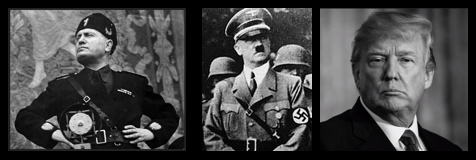
5. And fascism? Hitler was prelude to Trump. As for the concept of fascism: Aufheben (overcome, preserved, transcended; new realities, new scholarship, new formulations; America First as methodology: see Some Arrestees
. . . ; telephone threats; I.C.E. videos; Trump performances).
"He's not hurting the people he needs to be hurting."
concepts emerging out of America First as methodology:
1. talkin' shit (Trump rallies); 2. feeding the beast (blood lust,
sadism); 3. the Sado-sexual eigenvector of GOP performativity. This can be generalized: the Sado-sexual eigenvector of fascist performativity
|


mirror mirror on the wall . . .
|
Neuroplasticity vs. Racism
|
from from Merlin Donald, A Mind So Rare: the Evolution of Human Consciousness (W.W. Norton, 2001), pp. 301-2
. . . modern
culture contains within it a trace of each of our previous stages of
cognitive evolution. It still rests on the same old primate brain
capacity for episodic or event knowledge. But it has three
additional, uniquely human layers: a mimetic layer, an oral-linguistic
layer, and an external-symbolic layer. The minds of individuals
reflect these three ways of representing reality. 262
Something about our mentality changed in the past few millenia,
something that made us able to construct such exotic things as
symphonies, philosophies, oil refineries, nuclear weapons, and
robots. Do such achievements have implications for theories of
consciousness? Many would deny that they do. They would
claim that the parameters of mind were surely fixed long ago, when we
emerged as a species, and that culture can add nothing to an equation
written deeply into the human genome.
The human mind is so plastic in the way it carries out its cognitive
business, individually and in groups, that the core configuration of
skills that defines a mind actually varies significantly as a function
of different kinds of culture. This is especially true of the
most conscious domains of mind, such as those involved in formal
thinking and representation.
Literacy skills change the functional organization of the brain and
deeply influence how individuals and communities of literate
individuals perform cognitive work. Mass literacy has triggered
two kinds of major cogitive reorganizations, one in individuals and the
other in groups.
To become fully literate, the individual must acquire a host of neural
demons that are completely absent from anyone who lacks literacy
training. This involves massive restructuring. There is no
equivalent in the preliterate mind to the circuits that hold the
complex neural components of a reading vocabulary or the elaborate
procedural habits of formal thinking. These are unnatural.
They have to be hammered in by decades of intensive schooling, which
changes the functional uses of certain brain circuits and rewire the
functional architecture of thought. This process can be very
extensive. Consider the impact of twenty or more years of schooling on
the brain of someone who has acquired full symbolic literacy in several
different technical, mathematical, scientific, and musical
fields. These skills encumber neural resources on a vast scale
and change how the person's mind carries out its work.
|
 |
Nietzsche, Will to Power, preface:
What I
relate is the history of the next two centuries. I describe what
is coming, what can no longer come differerently: the advent of
nihilism.
|
 |
|
Racism at its most sophisticated is about character and cognition:
from Hunt Hawkins, “Heart of Darkness and Racism” in Heart of Darkness: Authoritative Texts--Backgrounds, and Contexts--Criticism, Paul B. Armstrong, ed. (Norton Critical Editions) pp. 373-4
“At some future period, not very
distant as measured by centuries, the civilized races of man will
almost certainly exterminate and replace the savage races throughout
the world” (Darwin, 1871)
“the higher—the more intellectual and moral—must displace the lower and more degraded races” (Wallace, 1864)
“The Anglo-Saxon has exterminated the less developed peoples with which he has come in competition.” (Kidd, 1894)
|
nihilism:
the dissolution of mind |
the Dissolution of Mind
Jonathan Haidt, The Anxious Generation: How the Great Rewiring of Childhood is Causing an Epidemic of Mental Illness (Penguin, 2024). sees the turning point at around 2010, before the
covid-induced disruption of education.
The same can
be said for
PISA Math Scores. Note that Asian scores did not decline.
Nordic, European, and Anglo-Saxon (except for the U.K.) declined sharply.
Artificial intelligence is the name given to the technological side of
the disintegration of mind. The election of Donald Trump is a
lagging indicator of the dissolution of Mind.
|
from
Mary Helen Immordino-Yang and Antonio R. Damasio, “We Feel, Therefore
We Learn: The Relevance of Affective and Social Neuroscience to
Education,” in Emotions, Learning, and the Brain: Exploring the Educational Implications of Affective Neuroscience (W. W. Norton & Company, 2015)
.
. . learning is dynamic, social, and context dependent because emotions
are, and emotions form a critical piece of how, what, when, and why
people think, remember, and learn. (p. 17)
In general, cognition and emotion are regarded as two interrelated aspects of human functioning. (p. 36)
Stephen J. Ceci, On Intelligence: A Bioecological Treatise on Intellectual Development, expanded edition (Harvard University Press, 1996)
As
one moves from one situation to another, is enough to cause shudders in
some research quarters. It represents a move toward a psychology
of situations . . . xvi
The term
intelligence is often used synonymously with "IQ", "g", or "general
intelligence", especially in some of the psychometric literature. .
. however, the ability to engage in cognitively complex behaviors
will be shown to be independent of IQ, g, or general intelligence . . .
cognitive complexity will be seen to be the more general of the two
notions and the one most theoretically important to keep in mind when
referring to intelligent behavior. 22
The literature that
we reviewed demonstrates that it is not sufficient for one to be
biologically endowed with a cognitive potential and even to be exposed
to appropriate opportunities for its crystallization: One also must be
motivated to benefit from this exposure. Performance is
influenced by learning, refinement, shaping, etc., and the role of
motivation cannot be ignored in such matters. Extrinsic
motivators (such as the value that one attaches to attaining success on
a task), as well as intrinsic motivators (inculcated through various
parenting styles, such as fostering autonomy, valuing schooling, and
adopting a modern world view . . ) are equally important in shaping
cognitive outcomes. 116
| The Dissolution of Mind: PISA Math Scores, 2003-2022

| 2003 2006 2009 2012 2015 2018 2022 |
|

3. Joe Bidinger, Pete Olshove, and Chester Podgorsky in
front of one of the large presses that produced the siderails for the
frame. In this interview Joe Bidinger describes the step-by-step movement of metal from raw input to finished output.
|
the New Deal
|

|
|
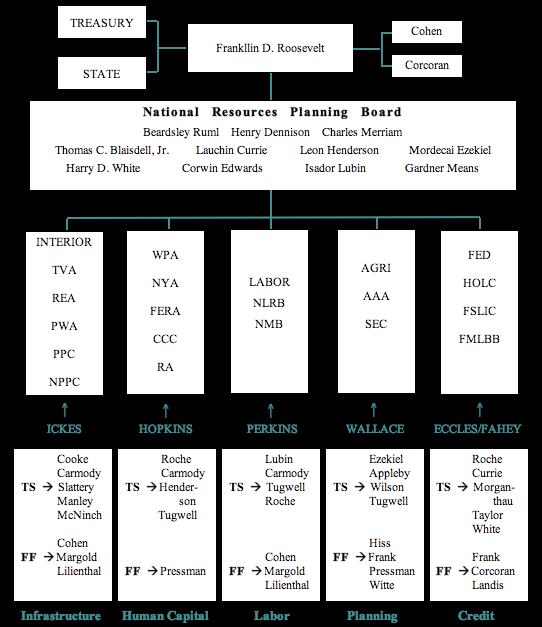
Intersubjectivity, Shared Intentionlity, and the Extended Mind: the Keynesian Elite in the
New Deal State, is an organizational chart of the Roosevelt
administration circa 1936. This particular social formation
(TS+FF) emerged out of the Eastern Rate Case of 1910, played a critical
role in the industrial side of the conduct of the First World War (when
FDR, Frankfurter, and the Taylor society linked up), and became, as
Figure 1a indicates, the socio-technical infrastructure of the New Deal
state. The work that produced this result can be found here:
"The Origins of the "Welfare State": The Keynesian Elite and the Second New Deal, 1910-1936" (manuscript, 1987)
Notice that it is possible to group the administrative
agencies of the New Deal state into five major groups: infrastructure,
human capital, labor, planning, and credit. Each group was
staffed by a set of Taylor Society "technocrats" and a
Frankfurter-linked lawyer. (See The Brandeis/Frankfurter
Connection: The Secret Political Activities of Two Supreme Court
Justices.)
The
Taylor Society emerged
in the course of
the Eastern
Rate Case
(1910), and is the Brandeisian wing of Progressivism: cosmopolitan,
enlightened,
and above all, committed to science.
Much attention has been paid to the middle class,
professional
character of this wing of progressivism (Otis Grahan Jr. Old
Progressives and New Deal); almost none to the vast array
of
modern firms that constituted the business milieu of Progressivism (Gal is the exception).
Study of these phenomena reveals the advanced capitalist nature
of what is almost
universally misconceived as some kind of coalition of middle class
reformers, workers, and farmers that was anti-business. In fact, a close study of the
Keynesian Elite in the New Deal state shows that not only was the
leading institutional formation of reform not anti-business (they
represented important parts of modern capitalism); and not merely
middle
class reformers (they were part of the emergence of the higher-order
functions of advanced capitalism that transcended the merely localized
praxis of the firm); they were the vanguard of
advanced capitalism. In fact, Morris L. Cooke refered to the Taylor Society as the spearpoint of
modern business (the less clumsy term vanguard was already taken in another context).
|
|
the Keynesian Elite in the New Deal State:
Intersubjectivity, Shared Intentionality, and the Extended Mind
Source: "Membership List, May 1927" in the Morris L. Cooke Papers, box 66, FDR Library,
and The United States Government Manual 1937. Also: the Papers of John M. Carmody
|
organization and geography matter
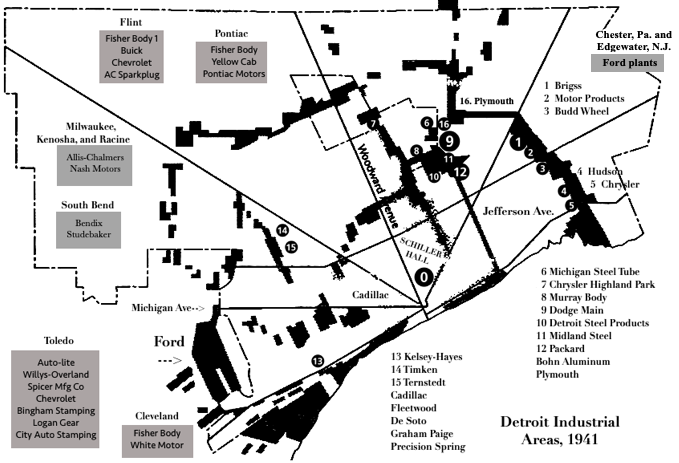
The UAW-Unity Caucus, 1933-1943: Intersubjectivity, Shared
Intentionality, and the Extended Mind (Bildungsproletarians and
Plebeian Upstarts), is a map of sources. While I interviewed
veterans of the organizational struggle from the Conner Avenue area on
the far east side of Detroit (Briggs, Budd Wheel, Hudson, and Chrysler), and workers from Fleetwood, Ternstedt,
and Ford on the west side of the city, the most intensive work was done
with veterans of the organizational struggle on the near east side:
Michigan Steel Tube, Chrysler Highland Park, Murray Body, Dodge Main,
Midland Steel, Detroit Steel Products, Packard, and Plymouth, and with
veterans of the organizational struggle in Flint (Fisher 1, Chevrolet, and Buick) and Pontiac (Pontiac Motors, Yellow Cab).
I had no idea at the time (the
mid-1970s) that these interviews would prove to be critical to a
reconceptualization of modernity as a mode of cognitive-discursive
performativity that includes the concepts of biocultural niche and bildung.
Nor could I have possible imagined that the cognitive-discursive
performativities upon which this site depends represented the high
point of the development of the biocultural niche of modernity ("The half century between the 1880s and the 1930s was the golden age of the book in the West."), at least in the United States.
What
made this whole site
possible is the literary and cognitive capabilities of the
bildungs-proletarians and plebeian upstarts whom I interviewed.
These
bildungs-proletarians inhabited the biocultural niche of modernity.
They were intensely rather that merely
literate. In
this regard they had more in common with the New Deal vanguard (above
right) than they had with the “masses” of their fellow workers in
the plants. For this reason it was
possible to co-construct a discursive web incorporating all the
interviews that, in another context, could be referred to as the
extended mind of the Unity caucus.
It was these bildungs-proletarians around whom formed the action
networks of plebeian upstarts (the Unity Caucus) who created the modern
UAW in the 1930s. From the standpoint of praxis both the Unity
Caucus and the Keynesian elite should be conceived of as vanguard
formations within the biocultural field of Progressivism.
The Unity caucus leadership was made up of communists and
socialists. Communists organized the Midland Steel and the Flint
sitdown strikes. Anti-communism qua semiotic regime
All of us historians who interviewed these workers back in the nineteen
seventies and eighties were not only struck by their powers of mind,
but also by what can only be described as their strength of
character. They were the embodiment of civic republicanism.
|
|
S
The
UAW-Unity Caucus, 1933-1943: Intersubjectivity, Shared Intentionality,
and the Extended Mind: Bildungsproletarians and Plebeian Upstarts
the UAW, 1933-1943: a working notebook
|
Herman Burt
Junious Pruitt
Levi Nelson
Oscar Oden
Harris
Anderson interview
Civil War roots of "factionalism"
|
|
Midland Steel (UAW local 410): Layout and Work-flow

|
|
Michigan Steel Tube (UAW local 238): Layout

This layout is from The Emergence of a UAW Local, 1936-1939: a Study in Class
and Culture (University of PittsburghPress, 1975). Edmund Kord, who was the
key organizer in this plant, was one of the bildungs-proletarians who was part
of the Reuther circle at Wayne StateUniversity in the 1930s. This plant layout
was drawn by Kord in the course of our discussions.
|
Eli Zaretsky, "The Mass Psychology of Trumpism" (London Review of Books, 18 September 2018)
Dick Lehr, White Hot Hate: A True Story of Domestic Terrorism in America's Heartland (Mariner Books, 2021)
|
|
the Fascist Mob at the Capitol, January 6, 2021: a phenomenological bundle
|
Eli Zaretsky, "The Mass Psychology of Trumpism" (London Review of Books, 18 September 2018
|
|
Data
This
is part of a larger sample that was the basis for
discussions between PF and RB that led to a series of
reconceptualizations, methodological as well as substantive, and is
provided so that the reader can have some idea of what we were working
with. The
failure of much of local journalism to provide basic facts re.
employment (occupation and industry) led me to cut short my efforts
to do all 212 individuals that I was working with. As it turned
out, this was sufficient material to think about, analyze, and draw
conclusions from.
Regional breakdowns.
This was the second step in arriving at the tables of arrestees from
selected states that became the basis for the comments on this page. Geography matters!
 New England
Southeast (north)
Southeast (south)
Mideast
Great Lakes
Plains
Southwest
Rocky Mountain
Far West
New England
Southeast (north)
Southeast (south)
Mideast
Great Lakes
Plains
Southwest
Rocky Mountain
Far West
As we reviewed these materials, it
became increasingly evident that the analysis out of the University of
Chicago (and mainstream media coverage in general) failed to comprehend
the major features of the dataset Arrests Arising out of the Assault on
Congress. A summray of our findings appears below.
Summary of findings
A close look at
the January 6 arrestees reveals that, contrary to the respectable
media, which claimed that "the
angry crowd at the Capitol . . . seemed to come
not from the fringes of American society but from white picket-fence
Main Street backgrounds," 1 what is found instead is a 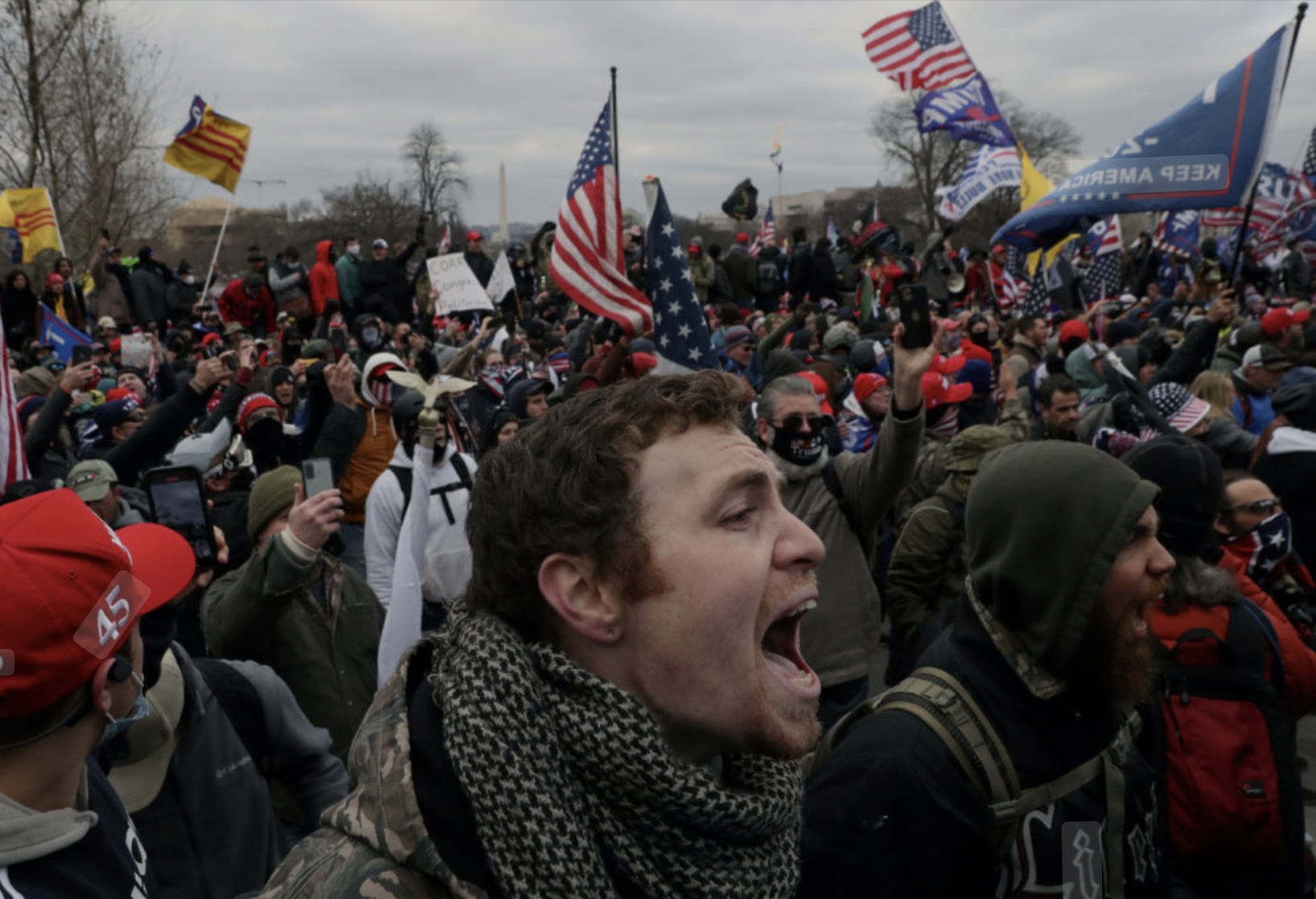 population in the process of
marginalization. The instability in their lives was manifested in
the difficulty of category formation. The standard occupational
and industry classifications 2 are inadequate, indeed
misleading. Gyms, bars, tatoo parlors, restaurants, salons, and
gun shops occur regularly in the entire dataset. To view the
individual owners of these establishments solely in terms of their role
as "shop owners" is misleading. What we are really dealing with
is social networks, not Cartesian selves. Very few if any of the
arrestees were connected to mainstream occupations and industries: none
in manufacturing, none in the building trades, none in the modern
corporate sector. They could be better characterized as grifters.
This is a challenge to the neat concept of class.
1. from the New York Times (January 26, 2021): "One
striking aspect of the angry crowd at the Capitol was how many of its
members seemed to come not from the fringes of American society but
from white picket-fence Main Street backgrounds — firefighters and real
estate agents, a marketing executive and a Town Council member."
2. North American Industry Classification System (U.S. Census Bureau)
Standard Occupational Classification System (Bureau of Labor Statistics)
|
|
|
|
|
|
This site is a rhizome.
Its principle of production is transcendental empiricism.
It uses figurative elements, including graphs, tables, charts,
and maps, originally to advance an analysis of the historical
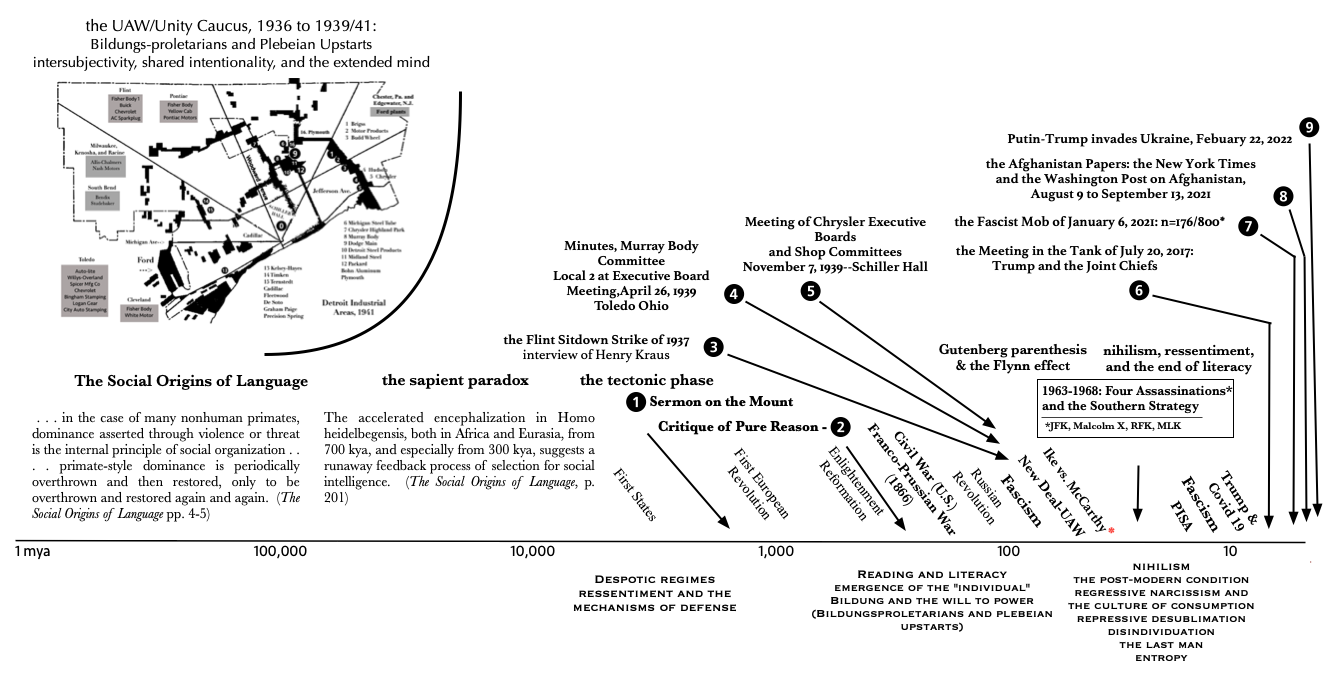
trajectory: the New Deal to Donald Trump, but the events of the second
decade of the 21st century, when viewed through the lens provided by
The Social Origins of Language, forced me to see that there was a
bigger picture. This bigger picture is represented by Figure 0.1.
From the Origins of Language to the End of Print Literacy in the United
States. Figure 0.1 is the irreducible minimum if one is to understand the New
Deal, "Trump," and the historical path connecting them. This is because "Trump" forces us to face the question of our primate heritage and its corrolary,
patrimonialism),
on the one hand, and the fragility of print-based civilization, on
the other.
Taking into account
the major perspectives on the development of
language and cognition, and applying these results and methodologies to
the cognitive-discursive performativities of schooling, politics, and
the media, we are led to a chilling conclusion: we are now
living through the disintegration of the cognitive-discursive
performativities associated with the biocultural niche of
modernity. What
is happening now is beyond the scope of current
popular and much scholarly thought, which is economistic in character and Cartesian in its
metaphysical presuppositions.
Cognitive performativity is a context-dependent, biocultural historical
phenomenon, not explicable within a discursive field shaped by the
Cartesian synthetic a priori.
The election of Donald Trump is a lagging indicator of the disintegration of cognitive performativities.
|
|
|
|
A History of Reading and Writing
As
well as the graphical materials, this site is made up of excerpts from
key texts, such as the one above (Lyons A History of Reading) the one at the right (Donald, A Mind So Rare. Longer excerpts are also part of this site: Geoff Eley's Nazism as Fascism, Weitz on the Nazis in Germany (Weimar Germany: Promise and Tragedy), Paxton's Anatomy of Fascism, and Eli Zaretsky's ; and this excerpt from A very Stable Genius about the meeting in the tank.
Excerpts from Eric D. Weitz, Weimar German: Promise and Tragedy (Princeton, 2007/2018), chapter 9, "Revolution and Counterrevolution from the Right" (pp. 331-360).
Zaretsky
the
disintegration of the cognitive-discursive
performativities associated with the biocultural niche of
modernity--this is the problematic of this site, energing only in the
second and especially third decades of the twenty first century.
key word: brain plasticity
key texts: Ceci, Donald, Dupre, Flynn, Paper
Ken Richardson's Understanding Intelligence (Cambridge, 20
Hiss list--PISA--Donald--Narcisism
|
|
|
nihilism
Nietzsche, Will to Power, preface:
What I
relate is the history of the next two centuries. I describe what
is coming, what can no longer come differerently: the advent of
nihilism.
Nihilism=the unwinding of mind
from
Mary Helen Immordino-Yang and Antonio R. Damasio, “We Feel, Therefore
We Learn: The Relevance of Affective and Social Neuroscience to
Education,” in Emotions, Learning, and the Brain: Exploring the Educational Implications of Affective Neuroscience (W. W. Norton & Company, 2015)
.
. . learning is dynamic, social, and context dependent because emotions
are, and emotions form a critical piece of how, what, when, and why
people think, remember, and learn. (p. 17)
In general, cognition and emotion are regarded as two interrelated aspects of human functioning. (p. 36)
A crtique of marxism:
marxism does not address the problematic of "cognition and emotion as
two interrelated aspects of human functioning." In marxism the
Cartesian metaphysic is still hegemonic. Thus, marxists
don't seem to be interested in actually existing
configurations of capital, nor are marxists open to the reality of
elite competition in an electoral environment, and the way in which
that can produce outcomes not reducible to "class interests". No
one seems to have any idea of where the New Deal came from, what it
was, and what happened to it. Relatedly, no one seems to have a
clue that "Trump", in terms of American politics, and geneologically
speaking, is a moment in the unfolding of Thermidor.
|
|
|
|
The Two-Party System (Semiotic Regimes): Elites and their Masses
MSNBC/CNN/
New York
Times/Washington Post
NIHILISM (Liberalism)
BILDUNG (Progressivism)
Commercial republicanism Civic republicanism
concrete-operational
and
formal-operational and
pre-operational
concrete operational
Fox News
RESSENTIMENT
Fascism
pre-operational and gestural
rentier sectors; provincial capitals; patrimonial
and predatory businesses and racist political ecologies
|
|
The Two-Party System (Semiotic Regimes ):
Cognitive Performativities and Emotional Configurations

|
LEFT*
|
RIGHT
|
Topology
|
depressive
|
paranoid-schizoid
|
Political style
|
progressive
|
proto-Dorian
|
Cognitive mode
|
concrete & pre-op
|
pre-op and gestural
|
Regime type
|
rational-bureaucratic
|
patrimonial
|
|
This disintegration of the cognitive-discursive performativities of
modernity
is one of the four major axes of the implosion of neo-liberal
"society."
The
UAW-Unity Caucus, 1933-1943: Intersubjectivity, Shared Intentionality,
and the Extended Mind (Bildungsproletarians and Plebeian Upstarts), is not only a map of sources. It was also an arena of
cognitive discursive performativities, and of emotional
sensibilities. At issue is the question of agency--the emotional forces
and the cognitive-discursive performativities of situated humans.
I had no idea at the time (the
mid-1970s) that these interviews would prove to be critical to a
reconceptualization of modernity as a mode of cognitive-discursive
performativity that includes the concepts of biocultural niche and bildung.
Nor could I have possible imagined that the cognitive-discursive
performativities upon which this site depends represented the high
point of the development of the biocultural niche of modernity ("The half century between the 1880s and the 1930s was the golden age of the book in the West."), at least in the United States.
This disintegration of the cognitive-discursive performativities of
modernity is one of the four major axes of the implosion of neo-liberal
"society." The term "society" is bracketed because, in the conventional
use of the term, an ontological stability is implied, whereas in
reality this society is in the process of blowing its brains out.
the other three: the explosion of fascist performativities within the
orbit of the GOP; the patrimonial assault on rational-bureaucratic
institutions and the triumph of nihilism.
Also at issue is the question of fascism; the problemmatic of fascism; the riddle of fascism.
And, above all, the question of anti-communism as the name I give to
the black hole at the heart of the public sphere that not only distorts
but determines the permissible boundaries and semiotic content of
public discourse. Gramsci raised the question of hegemony.
Harold Lewis Joins the Union
FF-FDR on "the forces" (FF deconstructs the presidency)
thoughts on republicanism (books)
|
|
|
Talkin' Shit/Feeding the Beast
anti-communism is the global (not local) property of the american semiosphere
|
|
from "Tracing the sensible: The development of an anthropological history of sensibilities", by Quentin Deluermoz, Thomas Dodman, Anouche Kunth, Hervé Mazurel and Clémentine Vidal-Naquet. In L'Homme, No. 247/248, L’expérience Sensible (juillet/décembre 2023), pp. 225-266
The
study of sensibilities naturally involves investigating specific
topics, but also, and above all, it means proposing a different
approach to the cultural, social, political, religious, and economic
spheres, by emphasizing the—often unnoticed or underestimated—ways in
which our individual behaviors, and the working of societies, are
influenced by our affective lives. The marginalization of the latter
can be linked to the characteristics of Homo academicus, a figure whose
very training draws on a long intellectual tradition of delegitimizing
the body, the senses, and the emotions, and who has tended to
overemphasize the ideas, reason, and interests of social and historical
actors (Bourdieu [1997] 2000), and overlook their affective import.
Since it is often perceived to be irrational and unpredictable, the
emotional sphere, for example, is often assumed to be intrinsically
anarchic. This preconception both leads to, and results from, ignorance
of the underlying dynamics that govern the life of affects (Braud 1996,
44). This is why, in our view, the history of sensibilities offers a
subversive and effective way of exploring past societies, their
tremendous diversity, and their quiet or conspicuous change over time.
. . . a
sensibility-based approach as a specific way of analyzing the social
sphere. [2] This approach necessarily challenges the major dividing
lines commonly drawn between nature and culture, the individual and
society, reason and emotion, and body and soul, and is thus
particularly attuned to anthropological questions.
The important
philosophical shift embodied, during the second half of the nineteenth
century, by the trio of the “masters of suspicion”: Friedrich
Nietzsche, Karl Marx, and Sigmund Freud. While in his Manuscripts of
1844, Marx described our five senses as formed by “a labour of the
entire history of the world down to the present,” and condemned
capitalist exploitation as a mutilation of sensibility (Marx [1844]
2007, 108), Nietzsche restored the philosophical dignity of sensibility
by rehabilitating the “great reason” of the body ([1885] 2008, 30), and
Freud pointed to the deceptiveness of consciousness and highlighted the
important role played by unconscious affective processes in our psyches.
|
|
|
Some Arrestees . . . A Phenomenological Bundle
1. Mob at Capitol
this is a raw and incomplete PDF that was the basis for
discussions between PF and RB that led to a series of
reconceptualizations, methodological as well as substantive. The
failure of much of local journalism to provide basic facts re.
employment (occupation and industry) led me to cut short my efforts
to do all 212 individuals that I was working with. As it turned
out, this was sufficient material to think about, analyze, and draw
conclusions from.
2. Regional breakdowns.
This was the second step in arriving at the tables of arrestees from
selected states that became the basis for the comments on this page:
As we reviewed states and other datasets, it became evident that the analysis out of the University of
Chicago (and mainstream media coverage in general) fails to comprehend the major features of the dataset Some Arrests from the January 6th Assault on Congress.
|
|
elementary particles
To see a world in a grain of sand
And a heaven in a wild flower,
Hold infinity in the palm of your hand
And eternity in an hour.
|
|
these
minutes are classic source materials, often footnoted to support a
point. Here these minutes are not source materials at all: they
are an elementary particle. "To see a world in a grain of sand",
in this case the world of concrete operational c/d
performativity. Note the flow of the discussion: the coherence
and the dense facticity of these performances. The focus and
attentivity. This is concrete operational c/d performativity at
the highest level.
|
|
the Secondary Leadership of Murray Body Discuss the
Competitive Situation in the Spring Industry, April 26, 1939
Minutes of the
Murray Body Committee Local 2 at Executive Board Meeting, April 26,
1939, Toledo Ohio, Addes Collection, Box 14.11, Reuther Archives. re. the competitive situation in the spring industry.
The members of the Local 2 Committee were:
Brother Hall from Spring &
Wire
Brother McDonnell from Stamping
Brothers Sanders and McWilliams
from Trim
Brother Smith from Frame (Ecorse plant)
Brother Manini,
Vice President
Also present was Executive Board member Walter Reuther
|
|
This is a description of Trump's on-the-job
|
|
Trump's
Meeting in the Tank with the Joint Chiefs on July 20, 2017
| Trump's
Meeting with the Joint Chiefs in the Tank on July 20, 2017 provides us
with a spectacular example--a performative tour-de-force--of this
accelerating disintegration of discursive and cognitive performativity. We have a detailed description of this meeting in A Very Stable Genius, chapter 9, "Shocking the Conscience."* A close reading of that chapter can be found here. The chapter in its entirety can be found here. |
|
Politics by Other Means:
the Kennedy Assassination and U.S. Political Economy by Sector, 1910 to 1948:
context and problematic
FDR and the forces
how the passions get embroiled in politics (primary and secondary passions: intetst and greed vs ressentiment
|
|
Fig. 1a.1. U.S. Political Economy by Sector, 1910 to 1948
input-output matrices: sectors of realization and the two-party system

Elites: Strategic and Otherwise
the Big Picture
|
|