
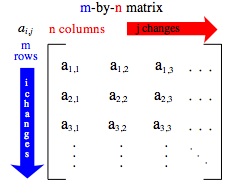
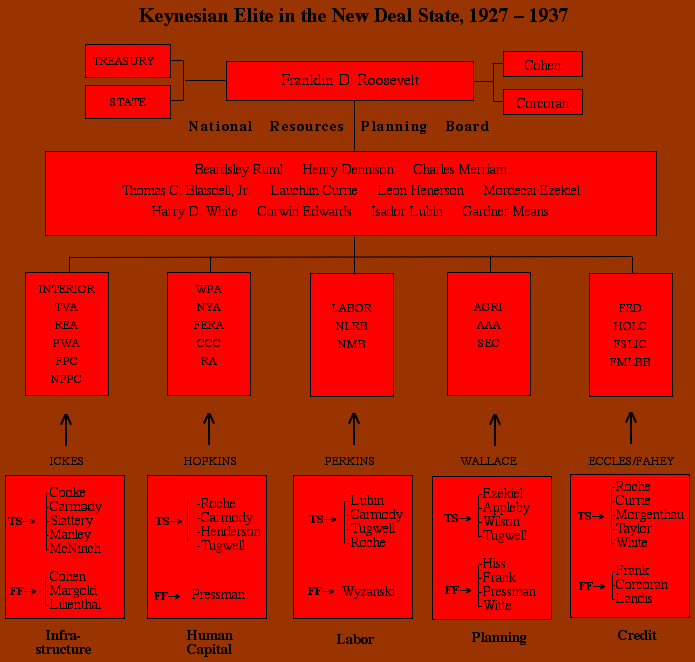
Input-output matrix is widely applicable as an analytical tool in analyzing the personnel matrix Keynsian elite (N=31), campaign contributions, interlocking directorates, and elite think tanks.
Input-output matrix can also be seen as an aspect of complexity and emergence. Hegel's dialectic similar to emergence; the problem of the driving force for transcendence and agency.
matrix defines field of emergence and praxiological infrastructure generating logos and praxis: specific input-output networks (KE and multiplier, input-output) (Securities Bloc)(Newton Baker 1932, Eliot Rosen)
Input-Output Matrix:
from Prophets of Regulation: Charles Francis Adams, Louis D. Brandeis, James M. Landis, Alfred E. Kahn, By Thomas K. McCraw, pp. 35-36
Zone
of
systems synthesis of mass, modern, and advanced capitalism, locus of
emergent
functions of the 'welfare state." The force-field of input
output
relations out of which the Keynesian elite emerged is suggested by the
membrship list (when intepreted in the context of the origins and
history of the Taylor Society and its milieu).
Advanced capitalism can be viewed as a phase in the unfolding
of
complexity. Its cosmopolitan, technocratic orientation lends
itself
easily to demonization from the right. Ironically, a cult of
the
primitive values of a nostalgically remembered
golden age of small business becomes in the
public sphere true capitalism, while advanced capitalism is demonized [Zombie Economics].
This is one of the great weaknesses of the American system of
power
when compared with the more advanced capitalist nations of Europe.
Advanced capitalism is politically weak in the United States,
undermined
by an alliance of small business, evangicals, provincial elites,
rentier industries (energy, insurance, securities bloc), and Wal Street, and it shows.
This is especially true of human capital development--which in
the twenty first century means achieving formal-operational competence among an increasing proportion of the population.
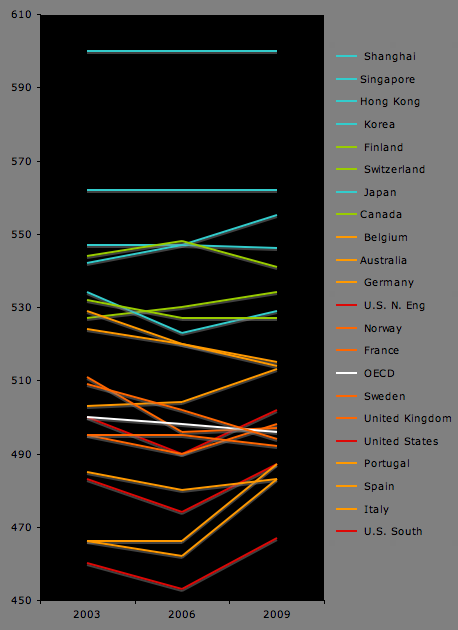
Thus the modern state of the twenty first century--committed to the broad development of human capital within a political framework misleadingly referred to as the welfare state--is virtually non-existent in the United States. This developmental crisis is indicated by figure 1
Thus the modern state of the twenty first century--committed to the broad development of human capital within a political framework misleadingly referred to as the welfare state--is virtually non-existent in the United States. This developmental crisis is indicated by figure 1
from Prophets of Regulation: Charles Francis Adams, Louis D. Brandeis, James M. Landis, Alfred E. Kahn, By Thomas K. McCraw, pp. 35-36
The commission tried the cocked-gun approach in a circular letter mailed out to all Massachusetts railroads in 1871. Adams' purpose was to promote rate reductions, by way of both enticements and threat. The letter . . . outlined the reduced costs brought by technological innovation ("The locomotive which formerly cost $30,000 now costs but $12,000"), the unusual opportunity now at hand ("Massachusetts is at this time susceptible of a very great and sudden industrial development"), and the payoff to the railroads thesmselves ("It is a pefectly well-established fact in railroad economy, that where a community in industrially in an elastic condition . . . a reduction of railroad charges within certain limits does not necessarilly involve any loss of net profits").
The content of the rate recommendations revealed Adams' preoccupation with aggregate economic growth. He emphasized, for example, a form of what economists later called the multiplier effect:
In
making
any reduction, whether in freight or fares, we would therefore suggest
to you [Massachusetts railroad presidents] the propriety of strongly
favoring certain commodities in general use along the line of the road,
and, by so doing, strongly stimulate development, rather than
neutralize the whole effect of any concessions you may make by dividing
it among too many objects. Take for instance coal . . . a
primary
raw material in all manufacturing industry. Cheap coal is
cheap
power; and cheap power is cheap manufacturing. A reduction of
five per cent. throughout the charges of tariff would scarcely produce
an appreciable effect on the consumption of anything; a tariff,
unchanged in numerous other respects, which gave a reduction of fifty
per cent. on the cost of carrying coal, would at once communicate an
impetus to every branch of industry dependent on power.
The
manner in which the United States pulled out of earlier depressions was
by making ownership pay the price of writing down inflated
capitalization through widespread bankruptcies, and by making labor pay
the price of unemployment. Following a period of drastic
surgery
"Theof this kind, new owners acquired productive properties
unencumberd, workers came back to work at lower wages, thus developing
a situation favorable to profits and activity along conventional
lines--and unfortunately to a resumption of the course that leads again
through speculation and inflation to another depression.
In respect of the depression which began in 1929, it was recognized by January 1932 that psychologically the corner around which renewed prosperity was believed to lie was too dangerous to be turned in the above conventional manner. The RFC was devised to ward off bankruptcies of the big fellows. Later a similar shoring-up was brought to bear more generally on industry, agriculture, and home-owners. Relief and public works were employed to restore purchasing power and stimulate business activity. These efforts were independent of simultaneous efforts to remove fundamental causes of depression. The stimulus of RFC was successful, but the burden of capitalization and debt carried over was too great for a spontaneous and rapid increase in business activity. The measure which had been taken to prevent universal bankruptcy was a measure which made impossible a rapidly accelerating progress out of depression.
In respect of the depression which began in 1929, it was recognized by January 1932 that psychologically the corner around which renewed prosperity was believed to lie was too dangerous to be turned in the above conventional manner. The RFC was devised to ward off bankruptcies of the big fellows. Later a similar shoring-up was brought to bear more generally on industry, agriculture, and home-owners. Relief and public works were employed to restore purchasing power and stimulate business activity. These efforts were independent of simultaneous efforts to remove fundamental causes of depression. The stimulus of RFC was successful, but the burden of capitalization and debt carried over was too great for a spontaneous and rapid increase in business activity. The measure which had been taken to prevent universal bankruptcy was a measure which made impossible a rapidly accelerating progress out of depression.
Taylor Society I: Keynesian Elite in the New Deal State
Taylor Society II: Member Firms, 1927

The Taylor Society III: Non-Mfg Organizations, 1927

Source: "Membership List, May 1927," in the Morris L. Cooke Papers, box 66, FDR Library
Alon Gal, Brandeis of Boston (Harvard University Press, 1980)
Harold Urofsky, ed., Letters of Louis D. Brandeis, Vol I (1870-1907): Urban Reformer (State University of New York Press, 1971); Vol II (1907-1912): People's attorney; Vol. III (1913-1915): Progressive and Zionist (State University of New York Press, 1971-78)
Milton J. Nadworny, Scientific management and the unions, 1900-1932; a historical analysis (Harvard University Press, 1955)
Nobuo Noda, How Japan absorbed American management methods (Asian Productivity Organization, 1969, 1982)